
Ghazi Sand Lab Report and Sieve Analysis for Plaster Work
A Ghazi Sand laboratory report provides technical information about a particular sample of sand. Depending on the project requirement, it may include sieve analysis, particle-size distribution, material passing the 75-micron sieve, fineness modulus, moisture content, organic impurities and other requested tests.
At Ghazi Sand Supply Company, we take random samples from the sand mine three times during the working day. We also take random samples from selected trucks after loading. Routine checks are performed in our office laboratory by a construction-materials technician trained at the Construction Institute of Technology, Rawalpindi.
When a customer or project requires additional verification, samples can be sent to external laboratories, including UET Taxila and Expert Solutions at Golra More, Islamabad, for the requested tests.
A laboratory report applies to the sample identified in that report. It should not automatically be treated as proof that every future truckload has exactly the same test result. For formal project approval, the report should be reviewed by the responsible engineer, consultant or client representative.
About Ghazi Sand
Ghazi Sand is natural sand sourced from the Ghazi–Tarbela region near Tarbela Dam in District Haripur, Khyber Pakhtunkhwa.
Ghazi Sand Supply Company specialises in supplying Ghazi Sand for plastering and finishing applications. Our customers include homeowners, contractors, builders, developers, civil engineers, consultants, procurement teams and larger construction projects.
Ghazi Sand is supplied for applications such as:
- Interior wall plastering
- Exterior wall plastering
- Ceiling plastering
- House plastering
- Commercial building plastering
- Wall finishing
- Repair and renovation work
- Institutional and large-scale plastering projects
Our company focuses on plaster sand rather than presenting Ghazi Sand as a universal material for every construction application. The final performance of plaster also depends on cement, water, mix ratio, plaster thickness, surface preparation, workmanship, curing and site conditions.
You can read more about the material in our guide: What Is Ghazi Plaster Sand?
What Is a Ghazi Sand Laboratory Report?
A Ghazi Sand laboratory report is a record of tests performed on an identified sample. A properly prepared report should provide enough information for a project team to understand what was tested, when it was tested and which method was used.
A laboratory report may include:
- Material description
- Sample identification
- Source information
- Sampling date
- Testing date
- Laboratory name
- Testing method
- Measured result
- Unit of measurement
- Applicable specification or acceptance limit
- Signature or authorisation of the responsible laboratory representative
When reviewing a report, check the sample details and test date carefully. A report without a clear sample identity, laboratory name, test method or testing date is difficult to evaluate for a professional construction project.
Why Testing Matters for Plaster Sand
Plaster is not made from sand alone. Its performance depends on the complete plastering system, including the selected sand, cement, water, mix proportions, surface preparation, application technique and curing.
Sand quality is still an important part of that system. Excessive clay, silt, dust, organic matter or inconsistent grading may affect the workability and finishing behaviour of a cement-sand mix.
Testing and material checks can help a project team review:
- Particle-size distribution
- Fine-material content
- General cleanliness
- Moisture condition
- Consistency between samples
- Suitability for the intended project specification
A laboratory test does not guarantee crack-free plaster, zero efflorescence or perfect finishing. It provides technical information that should be considered together with the complete construction method.
How We Sample Ghazi Sand at the Mine
We follow a regular sampling process as part of our internal material-monitoring procedure. Random samples are taken from the sand mine three times during the working day.
Taking samples at different times allows our team to monitor material from different loading periods. Natural source material can show variation because of changes in the loading location, moisture, weather, handling conditions and the material present at the time of loading.
After collection, the samples are taken to the laboratory at our office for routine checks under our internal procedure or for the relevant project requirement.
Random Checks from Loaded Trucks
Mine sampling is one part of our checking process. We also take random samples from selected trucks after loading.
This gives our team an additional opportunity to review the material that is actually being dispatched to a customer. The loaded-truck sample can be compared with the source material and checked for visible variation, contamination or other concerns identified during routine inspection.
We do not describe a random truck check as testing every truck. It is a practical monitoring step designed to support consistency between the mine, loading operation and dispatched delivery.
Who Performs the Routine Office Checks?
The routine office checks are performed by a construction-materials technician trained at the Construction Institute of Technology, Rawalpindi.
The technician carries out the daily examination of selected mine and truck samples according to the company’s internal checking procedure. The checks may include visual inspection, particle appearance, general cleanliness and other tests required for the material or project.
These office checks support our supply operations. They should not be confused with independent accreditation or formal project approval. Where a customer requires external verification, we arrange additional testing according to the project requirement.
External Laboratory Testing
Some customers and construction projects require testing by an external laboratory. When additional verification is requested, samples can be sent to laboratories selected or accepted by the customer, engineer or consultant.
Depending on the project requirement, customers may request testing through:
- UET Taxila
- Expert Solutions, Golra More, Islamabad
- Another laboratory specified or accepted by the project team
The exact laboratory, sample quantity, test method and reporting format should be agreed before testing. This is particularly important for larger projects, institutional work and contracts that require formal material approval.
External testing may be requested for:
- Sieve analysis
- Material passing the 75-micron sieve
- Fineness modulus
- Moisture content
- Organic impurities
- Clay lumps or other harmful material
- Chemical tests
- Other project-specific requirements
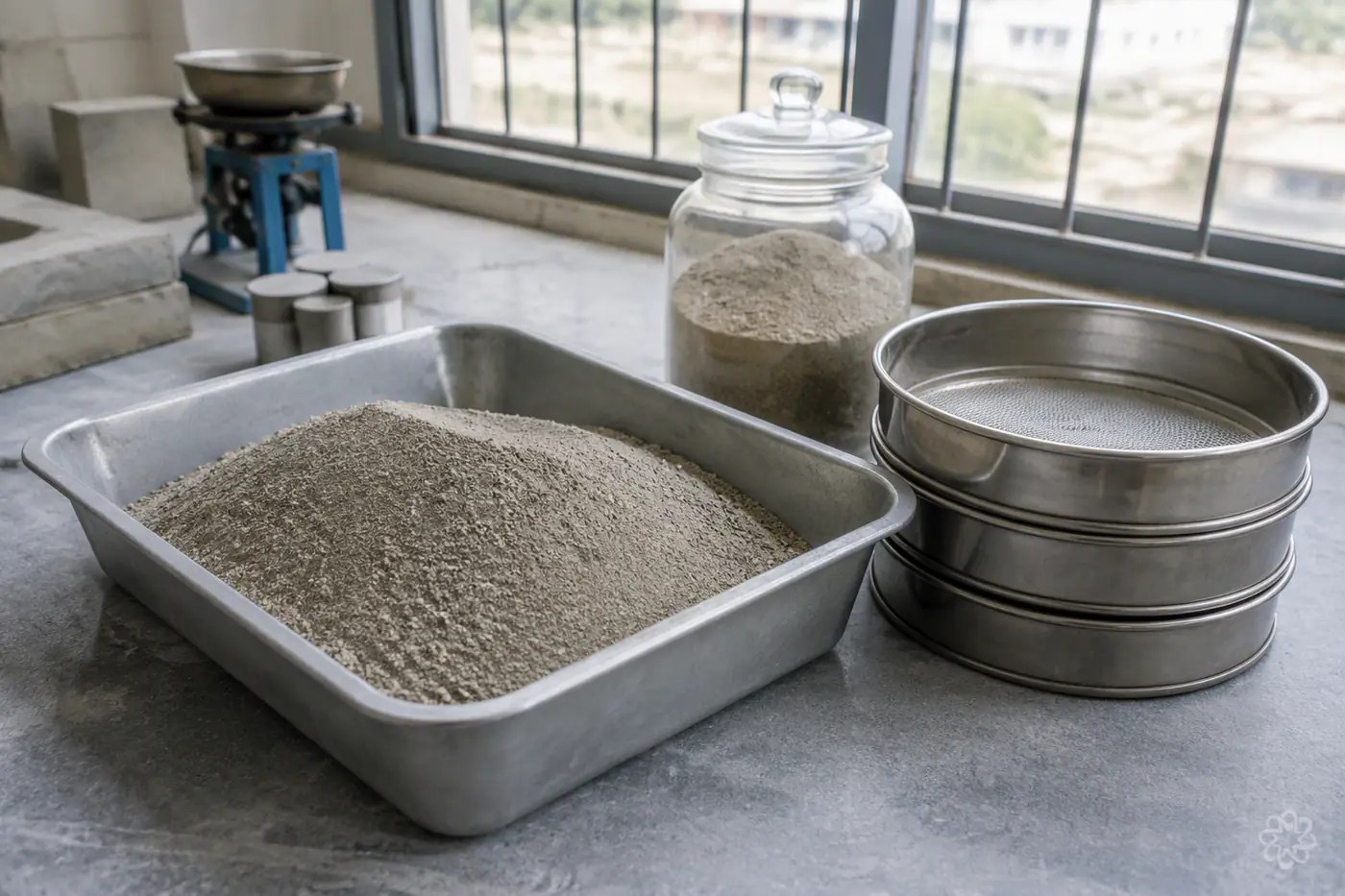
What Is Sieve Analysis?
Sieve analysis is a test used to determine the distribution of particle sizes in a sand sample.
During the test, a measured sample is passed through a series of sieves with different openings. The material retained on each sieve is weighed and recorded. The results are then used to calculate the percentage retained, cumulative percentage retained and percentage passing.
A sieve-analysis report may include the following information:
| Report item | What it shows |
|---|---|
| Sieve number | Identifies the sieve used during the test. |
| Opening size | Shows the size of the sieve opening. |
| Mass retained | Shows the amount held on a particular sieve. |
| Percentage retained | Shows the proportion retained on that sieve. |
| Cumulative percentage retained | Shows the total percentage retained up to that sieve. |
| Percentage passing | Shows the percentage of material passing through the sieve. |
Why Sieve Analysis Matters for Plaster Work
The grading of sand can influence mortar workability, water demand, trowel application, surface texture and finishing requirements.
Sand that is too coarse may produce a rougher surface. Excessive fine material may increase water demand or affect the behaviour of the cement-sand mix. A suitable grading should therefore be reviewed against the intended application and project specification.
There is no single sieve-analysis result that is automatically suitable for every plastering project. The acceptable grading depends on plaster thickness, mix design, construction specification and approval requirements.
What Does Material Passing the 75-Micron Sieve Mean?
The 75-micron sieve is commonly used to assess very fine material passing through that opening. Depending on the material and test method, this fraction may include dust, silt-sized particles or other fine material.
The report should clearly state the test method, sample identification, measured percentage, testing date and applicable project limit where one has been specified.
We avoid describing sand as completely “dust-free” or “silt-free” unless the actual test result and method justify that description. A technical report should use the measured result rather than a general marketing label.
What Is Fineness Modulus?
Fineness modulus is a calculated index based on the cumulative percentage retained on a defined set of sieves. It helps compare the general fineness of different sand samples.
Fineness modulus is not a complete quality certificate. Two sand samples may have similar fineness-modulus values while differing in clay content, organic impurities, moisture, particle shape, cleanliness or grading curve.
For this reason, fineness modulus should be reviewed together with the complete sieve-analysis table and other relevant laboratory results.
Other Tests That May Be Requested
Material passing the 75-micron sieve
This test examines the amount of very fine material present in the sample. The result should be interpreted according to the relevant test method and project specification.
Organic impurities
Organic material may affect cement-based construction materials. If this test is required, the laboratory report should state the method and result.
Moisture content
Moisture affects handling, storage and volume measurement. It can also affect batching decisions and comparisons between loose cubic-foot volume and delivered vehicle quantities.
Clay lumps and harmful material
Some projects require additional testing for clay lumps, friable particles, deleterious material or other harmful substances. These tests should be performed only when they are included in the agreed testing programme.
Chemical testing
Chloride, sulphate and other chemical tests may be required for particular projects. We do not describe these tests as completed unless they are included in the actual laboratory report.
How to Read a Ghazi Sand Test Report
Before accepting a report, check the following details:
- Material identity: Is the sample clearly described?
- Source: Does the report identify the material source?
- Sample date: When was the sample collected?
- Test date: When was the test performed?
- Laboratory: Is the laboratory identified?
- Test method: Is the method stated?
- Units: Are the results expressed clearly?
- Specification: Is the result compared with a relevant requirement?
- Sample scope: Does the result apply to a sample, batch or defined group of loads?
- Authorisation: Is the report signed or approved by the responsible laboratory representative?
A report should not be judged by one number alone. The complete sample, method, result and project context must be considered.
Office Checks and Independent Laboratory Tests
Our internal office checks and external laboratory testing have different purposes.
| Testing level | Main purpose |
|---|---|
| Mine sampling | Monitor source-material consistency during the working day. |
| Loaded-truck sampling | Check selected dispatches after loading. |
| Office laboratory checks | Perform routine internal monitoring. |
| External laboratory testing | Provide independent or project-specific verification. |
| Engineer or consultant review | Make the final project-approval decision. |
Internal checks support our supply process, but they do not replace independent testing where a project specification requires it.
Does One Laboratory Report Represent Every Truck?
Not automatically. A laboratory report represents the sample described in the report.
If a project requires every truck, every batch or a defined number of representative loads to be tested, the sampling procedure should be agreed before dispatch.
The agreed procedure may identify:
- Number of samples
- Sample size
- Sampling location
- Testing frequency
- Testing laboratory
- Test methods
- Report format
- Acceptance procedure
- Responsibility for testing costs
Practical Site Checks Before Use
Laboratory testing provides more reliable technical information, but a site team may also perform a basic visual inspection when a delivery arrives.
Site personnel may check for:
- Visible clay or mud
- Excessive dust
- Organic matter
- Unusual colour or smell
- Large unwanted particles
- Soil contamination
- Significant variation from earlier deliveries
- Excessive moisture
- Contamination during storage
Basic bottle-settling check
A bottle-settling check can provide a preliminary visual indication of fine material. It is not a substitute for laboratory testing.
- Take a representative sand sample.
- Place clean water in a transparent bottle.
- Add the sand sample.
- Shake the bottle thoroughly.
- Allow the material to settle.
- Observe whether a visible fine layer forms above the sand.
The result can be affected by the sample, water, shaking and settling time. It should not be used to claim an exact silt percentage or formal project compliance.
Can Ghazi Sand Be Used for Plaster Work?
Ghazi Sand Supply Company supplies Ghazi Sand primarily for plastering and finishing applications.
It may be considered for interior plaster, exterior plaster, ceiling plaster, wall finishing, repair work, residential construction, commercial construction and institutional projects.
The responsible engineer, contractor or consultant should confirm the suitability of the material for the intended mix, plaster thickness and application.
Can Ghazi Sand Be Used for Structural Concrete?
Our primary product focus is plaster sand. Structural concrete applications such as slabs, beams, columns and foundations require approval according to the project’s concrete specification.
Sand suitable for plaster is not automatically approved for structural concrete. The responsible engineer should review the grading, aggregate requirements and relevant test results before approving any material for reinforced concrete or other structural work.
Ghazi Sand Delivery for Project Requirements
Ghazi Sand Supply Company coordinates truck and dumper deliveries from the Ghazi–Tarbela source area to customers in Islamabad, Rawalpindi, Taxila, Wah Cantt, Hattar Industrial Area, Haripur, Hassan Abdal and nearby areas.
Delivery arrangements depend on the required quantity, destination, vehicle availability, road conditions, site access, unloading arrangements and requested delivery schedule.
Customers requiring technical documents should contact us before confirming a large order. Please provide the project location, required quantity, intended use, delivery date and any testing requirements issued by the engineer or consultant.
To learn more about the source area and route information, read: Ghazi Sand Mine Location and Route Guide
Frequently Asked Questions
What is included in a Ghazi Sand lab report?
The contents depend on the laboratory and project requirements. A report may include sieve analysis, material passing the 75-micron sieve, fineness modulus, moisture content, organic impurities and other requested tests.
How often do you collect samples from the mine?
We take random samples from the sand mine three times during the working day as part of our routine material-monitoring process.
Do you check loaded trucks?
Yes. We take random samples from selected trucks after loading to provide an additional check on the material being dispatched.
Who performs the daily office checks?
Routine office checks are performed by a construction-materials technician trained at the Construction Institute of Technology, Rawalpindi.
Can samples be tested by an external laboratory?
Yes. When additional verification is required, samples can be sent to UET Taxila, Expert Solutions at Golra More, Islamabad, or another laboratory accepted by the customer, engineer or consultant.
Does every truck receive a separate laboratory test?
No. Our process includes random mine sampling, random checks of selected loaded trucks and external testing when required. If a project requires every truck to be tested, that requirement should be agreed before dispatch.
What does sieve analysis show?
Sieve analysis shows the distribution of particle sizes in a sand sample. It records the material retained and passing through different sieve openings.
What is material passing the 75-micron sieve?
It is the portion of the sample that passes through a sieve with a 75-micron opening. It may include very fine dust or silt-sized material, depending on the sample and test method.
Is a lower fine-material result always better?
Not necessarily. The suitable result depends on the intended application and project specification. The complete grading and other test results should be reviewed together.
Does a laboratory report guarantee crack-free plaster?
No. Plaster cracking can be related to mix ratio, plaster thickness, curing, surface condition, movement, workmanship, moisture and other factors. Sand quality is one part of the plastering system.
Can I perform a site silt test myself?
You can perform a simple bottle-settling check for a preliminary indication, but it does not replace laboratory testing or formal project approval.
How can I request the latest available Ghazi Sand report?
Call or WhatsApp Ghazi Sand Supply Company with your project location, intended application, required quantity and testing requirements. We will discuss the available technical information and any external testing requirement.
Related Ghazi Sand Guides
- What Is Ghazi Plaster Sand?
- How Much Sand Is Needed to Plaster a House?
- Why Ghazi Sand Is Preferred in Islamabad
- Ghazi Sand Mine Location and Route Guide
Final Conclusion
A Ghazi Sand laboratory report should be understood as technical evidence about a defined sample. The most useful information usually includes the source, sample date, test date, sieve analysis, material passing the 75-micron sieve, fineness modulus where provided, organic impurities, moisture content, test method and applicable project requirements.
At Ghazi Sand Supply Company, our material-monitoring process includes random sampling from the sand mine three times a day, random checks from selected trucks after loading and routine examination in our office laboratory. These checks are performed by a construction-materials technician trained at the Construction Institute of Technology, Rawalpindi.
When customers require additional verification, samples can be sent to UET Taxila, Expert Solutions at Golra More, Islamabad, or another laboratory accepted by the project team.
Our role is to coordinate Ghazi Sand supply, technical information and delivery arrangements. Final approval for a specific construction project should always be made by the responsible engineer, consultant or client representative.
Request a Ghazi Sand Report or Quotation
To request the latest available laboratory information or a current delivery quotation, send us:
- Project location
- Required quantity
- Intended application
- Required delivery date
- Requested tests
- Engineer or consultant requirements
Phone: +92 318 5907006
WhatsApp: Chat with Ghazi Sand Supply Company
Address:
Ghazi Sand Mine, near Tarbela Dam
Village Ghazi, District Haripur
Khyber Pakhtunkhwa, Pakistan
Delivery areas: Islamabad, Rawalpindi, Taxila, Wah Cantt, Hattar, Haripur and surrounding areas.


